A growing library for jewelry and small-parts laser welding — video demos, starting parameters by material, and practical tips from the bench. Check back often, this section will keep growing.
Set pulse, current (or voltage on the 200P), frequency and spot — see the joules, the peak and average power, and how deep it will melt, before you strike the first shot. Works for every machine in the lineup, enforced against each one's actual rating.
Open the calculator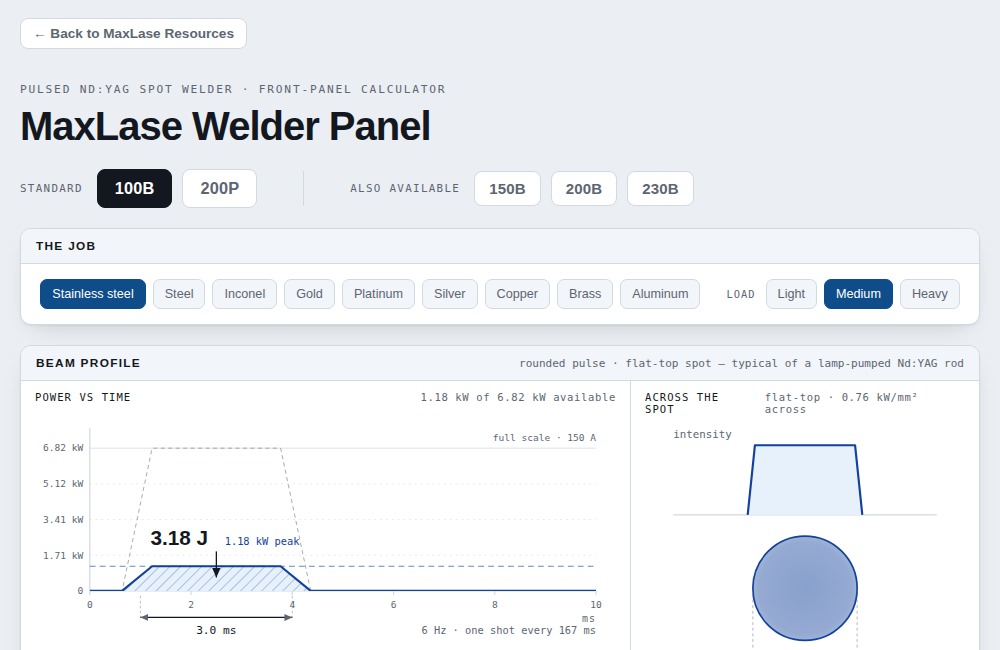
An 80-second look at the benchtop series: prong retips, ring sizing, specs up to the 200B, touchscreen controls, US support, accessories and other models. Some repair footage used with permission.
A walkthrough of installation, basic machine operation, and setup.
A walkthrough of the MaxLase 100B/150B/200B in operation.
A few outside demos we point customers to for technique reference — not filmed on MaxLase equipment, but useful for seeing laser welding technique in action.
Reference technique demo — LaserStar.
Reference technique demo — LaserStar.
Reference technique demo — LaserStar.
Baseline settings shown for a 200W system (the most common starting point). Lower-power systems (100W/150W) generally run at the higher end of the current range shown to hit the same result — see each product's spec page for model-specific tables. Always confirm on scrap before running a production part.
| Material | Pulse | Current | Frequency | Spot |
|---|---|---|---|---|
| Stainless steel | 2–4 ms | 10–20 A | 3–10 Hz | 0.8–3 mm |
| 18K gold | 1.5–3 ms | 20–40 A | 3–8 Hz | 0.8–2.5 mm |
| 925 silver | 2–3 ms | 60–70 A | 3–6 Hz | 0.3–0.8 mm |
| Red copper | 2 ms | 70–100 A | 2–3 Hz | 0.2–0.6 mm |
| Aluminum | 2–5 ms | 40–60 A | 3–6 Hz | 0.5–1.5 mm |
Full model-specific tables: MaxLase 100B, 150B, 200B, 230B, 200P.
Short, practical notes — this list grows as we publish more. Have a tip or technique worth sharing? Send it our way.
Metal purity, plating, and prior heat history all shift what "correct" settings look like — a 30-second test weld on scrap saves a ruined piece.
Oils, polish residue, and oxidation cause inconsistent welds and pitting. A quick ultrasonic clean or alcohol wipe before welding makes a visible difference.
When welding near a mounted stone, dropping frequency and pulse width reduces heat buildup — keep an eye on total pulse count during longer repairs.
Send us your part or application and we'll walk you through it.